
Quick read
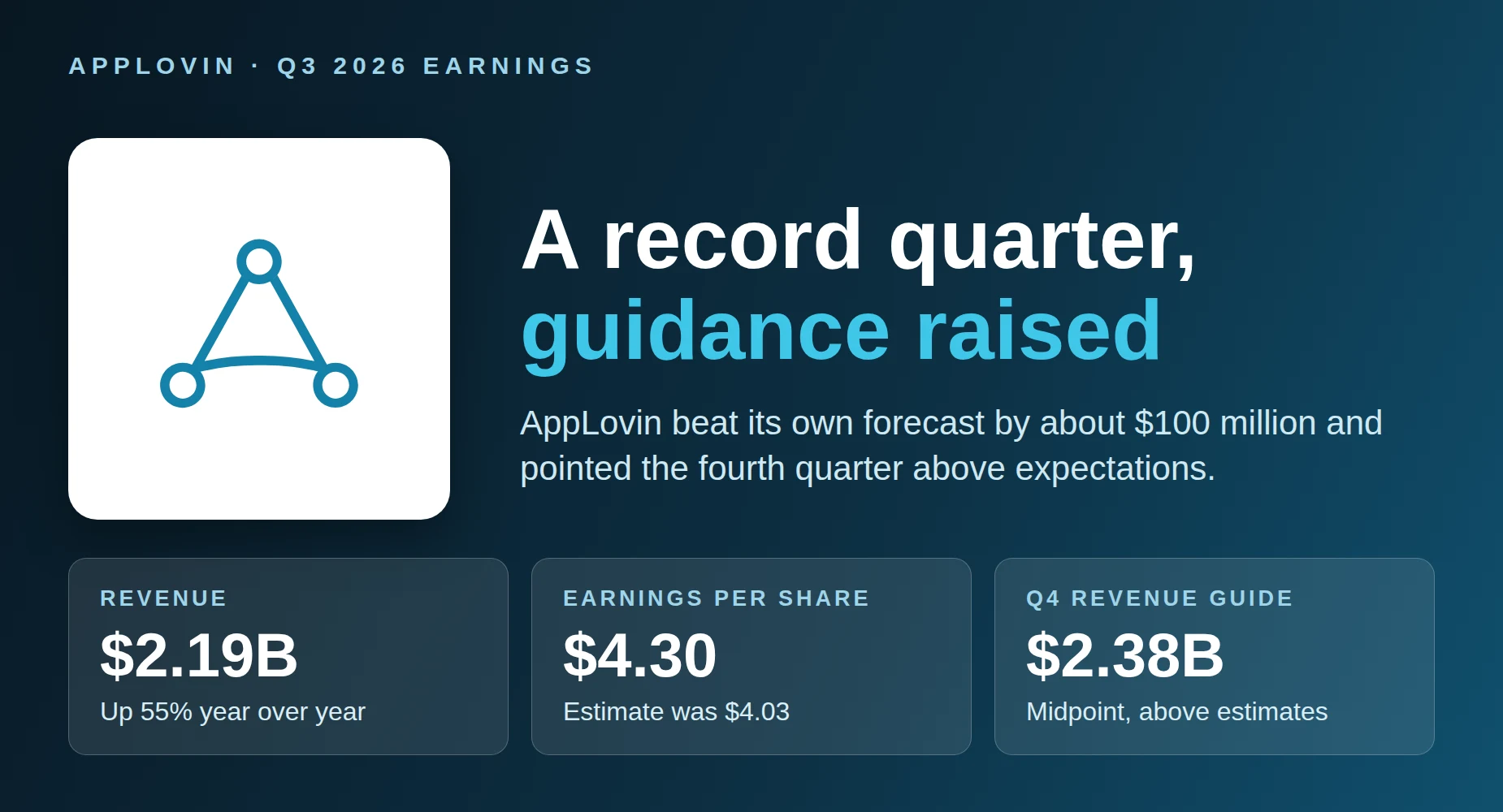
- Revenue rose 55% to $2.19 billion, about $100 million above the top of the company's own guidance
- Earnings of $4.30 a share beat the $4.03 consensus estimate
- Fourth-quarter revenue guidance of $2.365 billion to $2.395 billion came in above expectations
- Free cash flow reached $1.4 billion and the buyback authorization was raised to $3.6 billion
AppLovin (APP) reported third-quarter results after the close on Wednesday, November 4, and cleared every bar in front of it: the guidance the company set in August, the estimates analysts had pencilled in, and the lower expectations that came with a bruising year for the stock. Revenue rose 55% from a year earlier to $2.185 billion, a record for the company. Net income rose 72% to $1.439 billion, and diluted earnings came to $4.30 a share against the $4.03 consensus estimate reported by FactSet.
| Measure | Q3 2026 | Change from a year earlier |
|---|---|---|
| Revenue | $2.185 billion | +55% |
| Net income | $1.439 billion | +72% |
| Diluted earnings per share | $4.30 | from $2.45 |
| Adjusted EBITDA | $1.842 billion | +59% |
| Free cash flow | $1.4 billion | +35% |
Adjusted EBITDA is a profit measure that strips out interest, taxes, stock pay and some other costs; at $1.842 billion it equalled 84% of revenue. Net income equalled 66% of revenue. Numbers like those are why the debate around AppLovin is rarely about whether the business makes money. It is about how long growth at this pace can last, and whether the data engine behind it is as durable as the results suggest.
The beat started with the company's own forecast
The most telling comparison is not with analysts but with AppLovin itself. In August, management guided third-quarter revenue to between $2.055 billion and $2.085 billion. The quarter landed about $100 million above the top of that range. Adjusted EBITDA guidance of $1.71 billion to $1.74 billion was beaten by a wider margin. Analysts had expected revenue of $2.07 billion, according to CNBC, so the print cleared the Street as well.
Growth also re-accelerated. Revenue grew 55% year over year, up from 53% in the second quarter, and rose 14% from the second quarter, when sequential growth had slowed to 4%.
What drove it: better ads, not more ads
AppLovin sells advertising technology to mobile game studios and other app makers. Its Axon platform uses artificial intelligence to decide which ad to show a player, in which game, and what that slot is worth to an advertiser. The third quarter's growth came from squeezing more value out of each placement rather than from placing more ads: the company's quarterly report shows net revenue per installation up 55%, while installation volume rose just 2%.
Finance chief Matt Stumpf said on the earnings call that the beat came primarily from the core mobile gaming business, helped by improvements to the advertising models. Management also said a new generation of those models was partly rolled out during the quarter, without giving a date for the full rollout. That partial rollout matters because the second quarter went the other way: model improvements arrived more slowly than usual, revenue of $1.92 billion missed the roughly $1.94 billion analysts expected, and the shares fell hard.
Guidance: raised, with a slower pace built in
For the fourth quarter, AppLovin guided revenue to between $2.365 billion and $2.395 billion, above the roughly $2.25 billion analysts had expected, and adjusted EBITDA to between $1.995 billion and $2.025 billion, a margin of 84% to 85%.
The raise comes with a caveat that sceptics will focus on. At the midpoint, the fourth-quarter guide implies growth of about 43% to 44% from a year earlier and 8% to 10% from the third quarter. That is a step down from the third quarter's 55% growth. AppLovin has a habit of guiding conservatively and beating its own range, as this quarter showed again, but on paper the trajectory points to slower growth from here.
Cash and buybacks
The cash machine kept pace with the profit figures. Operating cash flow and free cash flow were each about $1.4 billion in the quarter. AppLovin spent $1.4 billion repurchasing shares or withholding them for tax on employee awards, covering 4.1 million shares, and the board raised the total share repurchase authorization by $3.2 billion, to $3.6 billion as of the end of October.
Why the bar was low
The size of the reaction says as much about the setup as the numbers. The shares had fallen about 59% during 2026 before the report, hit by the August revenue miss and by shareholder lawsuits filed after that drop over what the company had said about the pace of its model improvements. Behind that sits a longer contested history. In early 2025, short sellers Fuzzy Panda Research, Culper Research and Muddy Waters published reports alleging that AppLovin misused data and broke platform partners' rules; the company denied the claims. Bloomberg reported in October 2025 that the Securities and Exchange Commission was examining AppLovin's data collection practices following a whistleblower complaint. On the August 2026 earnings call, Stumpf said the SEC had concluded its inquiry with no recommended action; the SEC has not commented publicly. AppLovin also sold its own mobile game studios to Tripledot Studios in a deal that closed on June 30, 2025, for $400 million in cash plus an equity stake of about 20%, leaving a pure advertising business.
The reaction, and what the stock now prices in
AppLovin closed on Wednesday at $271.75 and was trading at $320.90 in pre-market trading on Thursday, up 18%, with a market value of $91.29 billion at the close, a trailing price-to-earnings ratio of 20.89 and a stock rating of 91.2. The 52-week range runs from $228.50 to $733.60, so even after the jump the shares sit far below where they traded a year ago.
Analyst reaction was measured rather than euphoric. Goldman Sachs analyst Eric Sheridan raised his price target to $445 from $400 and kept his Hold rating, describing himself as constructive on AppLovin over the long term while asking for more visibility into whether the growth rate holds after several volatile quarters.
The open questions
Three questions decide where the story goes next.
The first is concentration. Growth still comes mainly from mobile game advertising. The expansion into e-commerce and wider consumer advertising is the second engine investors are waiting to see at scale, and this quarter's numbers were powered by the core gaming business instead.
The second is the model cycle. The quarter showed what happens when a new model generation lands, and the second quarter showed what happens when it slips. With the latest generation only partly rolled out and no full launch date given, the timing of the next uplift is unknown.
The third is the growth path itself. A company growing at 55% with an 84% EBITDA margin can justify a lot, but the fourth-quarter guide already points to the low 40s. If growth settles there or lower, the valuation debate reopens; if the new models push growth back up, the beaten-down share price leaves room for the argument that Wednesday's numbers settled it. The print answered the questions raised in August. It also set a higher bar for February.
This article is for information purposes only and is not financial advice.