
Quick read
- Q3 revenue rose 4% to $24.19 billion and the net loss narrowed to $116 million from $5.34 billion a year earlier
- Free cash flow was positive at $464 million, and total backlog reached a record $745 billion with over 6,300 commercial airplanes
- The 737 rate of 47 a month now arrives in early 2027, the 500 delivery target for 2026 will be missed, and 52 a month is targeted for the second half of 2027
- Free cash flow guidance fell to about $3 billion for 2027 and $6 billion for 2028, against analyst expectations of $5.6 billion and $9.6 billion
- Defense revenue rose 15% to $7.94 billion and Global Services earned an 18.3% operating margin, while Commercial Airplanes lost $697 million
For a few hours on Tuesday, October 27, Boeing (BA) had the kind of quarter the turnaround story needed. Revenue rose, the loss shrank to a fraction of last year's, cash flow turned positive and the order book hit a record. Then management started talking about next year, and the stock gave up about 11% in a single session, closing at $168.18, its worst day since 2020. The quarter was not the problem. The timetable was.
What happened
Boeing reported third quarter revenue of about $24.2 billion, up 4% from a year earlier, helped by higher defense and services volume. The net loss narrowed to $116 million, against a $5.34 billion loss in the same quarter of 2025, when a charge on the 777X program weighed heavily on the result. On the measure Boeing calls core earnings, which strips out pension related items, the loss was $0.34 a share, wider than analysts had expected.
Cash moved in the right direction. Operating cash flow reached $1.5 billion, even after roughly $0.7 billion of Department of Justice settlement payments, and free cash flow, the cash left after spending on property, plant and equipment, was positive at $464 million. A year earlier the same quarter produced $238 million, and the first nine months of 2026 are still slightly negative on that measure, at minus $359 million.
The order book is not the issue either. Total backlog grew to a record $745 billion, including more than 6,300 commercial airplanes worth $612 billion. Commercial Airplanes alone took 300 net orders in the quarter, from customers including Turkish Airlines, Ethiopian Airlines and Lufthansa.
The numbers that matter
| Figure, Q3 2026 | Value |
|---|---|
| Revenue | $24,188 million |
| Change from Q3 2025 | +4% |
| GAAP net loss | $116 million |
| GAAP loss per share | $0.26 |
| Core loss per share | $0.34 |
| Operating cash flow | $1,496 million |
| Free cash flow | $464 million |
| Total backlog | $745 billion |
| Commercial deliveries in the quarter | 161 |
| Cash and marketable securities | $20.7 billion |
| Consolidated debt | $45.9 billion |
The split inside the company matters as much as the totals:
| Segment, Q3 2026 | Revenue | Operating result | Margin |
|---|---|---|---|
| Commercial Airplanes | $10,720 million | $697 million loss | (6.5)% |
| Defense, Space and Security | $7,935 million | $492 million profit | 6.2% |
| Global Services | $5,574 million | $1,019 million profit | 18.3% |
Commercial Airplanes, the business that builds the 737, 787 and 777, delivered 161 airplanes in the quarter, one more than a year earlier, yet its revenue fell 3% and it lost money again. Boeing blamed a less favorable delivery mix, meaning a higher share of lower priced variants, plus higher projected costs tied to future production rate changes and supply chain costs. Defense and services, by contrast, made money at healthy rates and carried the group result.
Why the stock fell anyway
Deliveries are where Boeing turns metal into cash. Airlines pay most of the price of a jet when it is handed over, so every delay in the production ramp pushes cash further out. That is why the guidance, delivered by chief executive Kelly Ortberg in a CNBC interview and on the earnings call, landed so hard.
Three pieces of it matter:
- The 737 production rate of 47 a month, a target Boeing had hoped to reach this past summer, will not be reached until early 2027. Wing production has been running slower than planned.
- Because of that delay, Boeing will miss its target of 500 737 deliveries in 2026.
- The next step up, 52 a month, is now targeted for the second half of 2027, and the 787 and 777 freighter programs have production challenges of their own.
The cash outlook moved with the timetable. Boeing now expects free cash flow of about $2 billion in 2026, about $3 billion in 2027 and about $6 billion in 2028, rising to about $10 billion in 2029. Analysts had penciled in about $5.6 billion for 2027 and $9.6 billion for 2028, according to LSEG data reported by Reuters. In plain terms, the recovery in cash generation has shifted roughly a year to the right, while the debt taken on during the crisis years, $45.9 billion at quarter end, still has to be serviced and repaid from that cash.
Ortberg's position, stated repeatedly on the day, is that the pace will not be forced. Boeing's quality problems of recent years were widely attributed to pushing production rates up faster than the factories and suppliers could handle, and the Federal Aviation Administration, the US aviation regulator, still oversees the ramp closely. Going slower is the safer choice operationally. It is also the more expensive one financially, and Tuesday's share price move was the market repricing that trade off.
The bull case
The optimistic reading starts with demand. A $745 billion backlog, more than 6,300 commercial airplanes and 300 net orders in a single quarter describe a company with years of work already sold, in a market where the only real rival, Airbus, also has a long waiting list. Airlines cannot easily go elsewhere, so delayed deliveries are mostly deferred revenue rather than lost revenue, as long as the delays stay measured in quarters and not years.
The rest of the group is performing. Defense, Space and Security grew revenue 15% to about $7.9 billion, lifted its operating margin to 6.2% and built a record $101 billion backlog, helped by selection for the US Navy's F/A-XX next generation fighter and a seven year award to expand production of PAC-3 missile seekers. Global Services, the maintenance and parts business, earned an 18.3% operating margin on $5.6 billion of revenue and tends to be steadier than jet building.
Regulatory milestones, long a bottleneck, are moving. The 737-7 received its amended type certification, the formal approval that a design meets safety rules, during the quarter, and the larger 737-10 received certification in October, clearing two variants that had waited years. The 787 is stable at 8 a month and the 777X remains on track for first delivery in 2027. And the losses are shrinking fast: a $116 million net loss is a different world from the $5.34 billion loss a year ago, with free cash flow positive in the quarter.
The bear case
The cautious reading starts with credibility. This is not the first slipped timetable, and each delay pushes the same cash flows into a later year, where they are worth less and depend on more things going right. Commercial Airplanes has now lost money in a quarter with 161 deliveries, which raises an uncomfortable question about what the unit earns even when production does rise, if rate changes and supply chain problems keep adding cost.
The balance sheet limits patience. Debt of $45.9 billion against $20.7 billion of cash and marketable securities means Boeing needs the delayed cash to arrive roughly as now planned. Another slip in the 737 ramp, further trouble on the 787 or 777 freighter, or new settlement and remediation costs of the kind that produced the $0.7 billion of Department of Justice payments this quarter would tighten that arithmetic quickly.
There is also a competitive cost that does not show up in a single quarter. Every year spent below planned output is a year in which Airbus delivers more of the single aisle jets airlines actually need, builds the larger installed base, and sells the services that follow those aircraft for decades. Boeing's backlog protects it for now, but backlog is only valuable if the factories eventually convert it into deliveries at a profit.
What happens next
The milestones to watch are concrete. Stabilized 737 output at 47 a month in early 2027, the step to 52 a month in the second half of that year, first delivery of the 777X in 2027, and free cash flow tracking toward the roughly $3 billion now expected for 2027. None of them requires a new product or a new market, only factories doing what they already do, faster, without the quality failures that made speed dangerous in the first place. Tuesday's reaction showed how much of the story now rests on timing rather than demand. Boeing has the orders. The open question is how long shareholders wait for them to turn into cash.
This article is for information purposes only and is not financial advice.
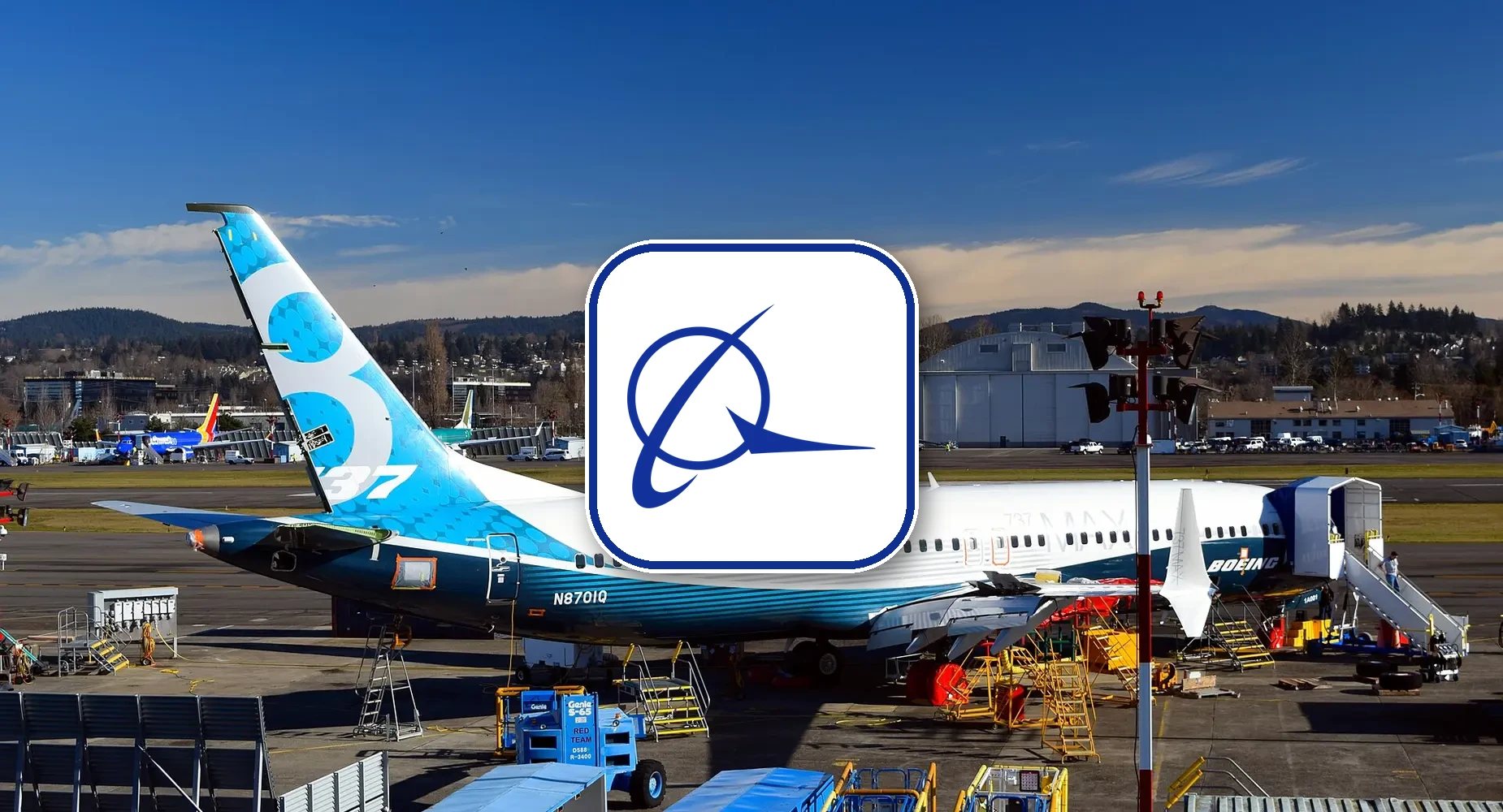
Cover: a Boeing 737 MAX in Boeing livery at Renton. Photo by John Crowley (CC BY-SA 2.0), via Wikimedia Commons.