
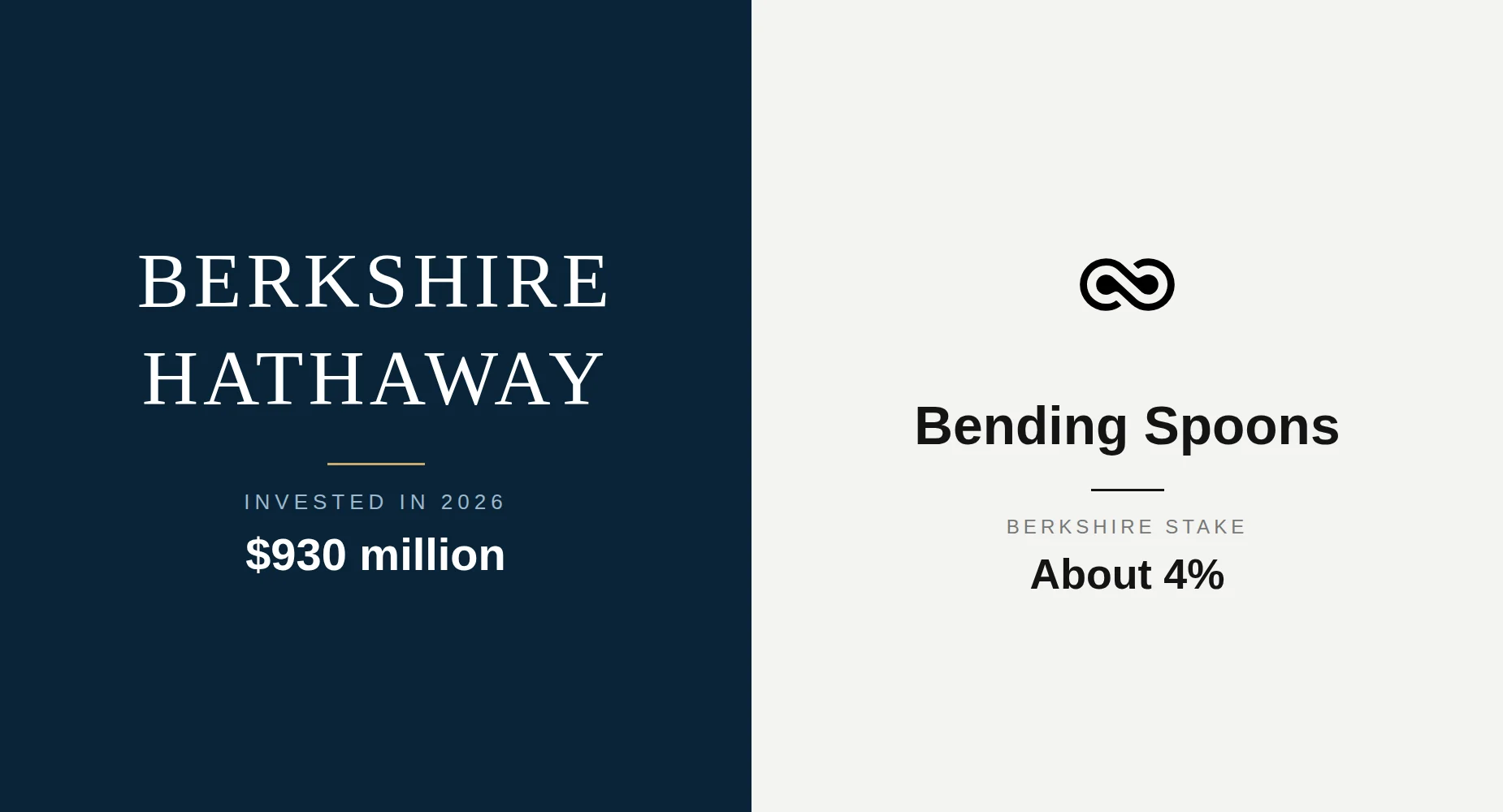
Is Bending Spoons Cigar Butt Investing 2.0? Berkshire Paid $930 Million to Find Out
Quick read
- Berkshire invested $600M at the July 2026 IPO and a further $330M at $33 a share in a placement that closed Oct 29, 2026, taking it to about 4%
- Bending Spoons' revenue reached $1.31B in 2025, with adjusted EBITDA of about $700M and guidance of about $1.4B for 2026
- BSP closed at $45.38 on Nov 2, 2026, a market value of about $29B and roughly 138 times trailing earnings, while Berkshire's average cost is about $30 a share
- The company has made more than 50 acquisitions and says it has never sold a material business
What Berkshire has done
Berkshire Hathaway (BRK.B) has invested $930 million in Bending Spoons (BSP) in under four months, and it did so in a way Warren Buffett spent decades avoiding: it bought into an IPO. Berkshire put $600 million into the Milan company's Nasdaq listing on July 1, 2026, a fact that only became public on October 14, 2026, when Bending Spoons announced a second, larger-in-signal investment. Berkshire agreed to buy 10 million newly issued shares at $33.00 each in a private placement, meaning a direct sale of new shares by the company rather than purchases on the open market. The placement closed on October 29, 2026, took Berkshire to about 4% of the company, and made it the sixth-largest investor, according to LSEG data. The money goes to general purposes and, mainly, more acquisitions.
This is the post-Buffett Berkshire. Greg Abel took over as chief executive on January 1, 2026, and said in his first shareholder letter that responsibility for equity investments ultimately sits with him, with investment manager Ted Weschler running about 6% of the portfolio. Berkshire has not said which of them picked Bending Spoons, and it declined to comment when Barron's asked. Scale matters too: Berkshire held about $359 billion in cash and Treasury bills at June 30, 2026, so $930 million is roughly a quarter of 1% of the pile. The position is small. The endorsement is the story.
| Detail | IPO investment | Private placement |
|---|---|---|
| Date | July 1, 2026 | Announced Oct 14, 2026; closed Oct 29, 2026 |
| Amount | $600M | $330M |
| Price per share | $29.00 | $33.00 |
| Shares bought | About 20.7M | 10M |
| Berkshire stake after | Not disclosed at the time | About 4% (about 31M shares in total) |
What Bending Spoons actually does
Bending Spoons, founded in Milan in 2013, buys well-known digital products whose owners have lost interest in them, then rebuilds them and keeps them. The portfolio reads like a museum of the consumer internet: AOL, bought from Yahoo in October 2025 with a $2.8 billion debt package arranged to fund the deal, plus Evernote, Vimeo (bought for $1.38 billion), Eventbrite, WeTransfer, Brightcove and Airtable (bought for about $1.29 billion), with a deal for Miro, at about $1.36 billion, signed in September 2026. In total there have been more than 50 acquisitions, and the company says it has never sold a material business.
The playbook is consistent. Cut costs hard, often including large parts of the workforce: WeTransfer lost about three quarters of its staff within weeks of its sale. Rebuild the technology on Bending Spoons' own platform: the company points to a rewritten Evernote and to a sharp fall in stability problems at Vimeo. Raise prices: Evernote's personal plan nearly doubled and its free tier was capped. Then hold the product forever and use its cash to buy the next one. In chief executive Luca Ferrari's words on a Sequoia podcast, the company buys off its own balance sheet, has never sold a material business, and does not intend to: it buys to hold and operate forever, but, unlike Berkshire, it transforms the businesses deeply rather than leaving them alone.
The financials, from the IPO prospectus, show why the model attracts capital. Revenue rose from $387 million in 2023 to $1.31 billion in 2025, with subscriptions at about 84% of the total. Adjusted EBITDA, earnings before interest, tax and some items management treats as one-offs, was about $700 million in 2025, and guidance for 2026 is about $1.4 billion. The first quarter of 2026 produced the first outright profit, about $28 million on $601 million of revenue. The portfolio reaches more than 500 million monthly users, with over 9 million paying customers.
The cigar butt test
A cigar butt was the young Buffett's favourite find, an image he took from his teacher Benjamin Graham. A discarded cigar butt on the street has one puff of smoke left in it; pick it up for nothing and that puff is pure profit. In business terms: a mediocre, fading company bought so cheaply that even a business in decline throws off more cash, or sells for more, than the price paid. Buffett later concluded the approach was a mistake at Berkshire's scale, and, pushed by Charlie Munger, moved to the opposite rule: a wonderful company at a fair price beats a fair company at a wonderful price. So is Bending Spoons the cigar butt strategy with better software? Point by point:
Where the label fits. The shopping list is pure cigar butt. AOL, Evernote, Meetup and WeTransfer are faded brands their owners had stopped investing in, the digital equivalent of the discarded butt. Sellers accept modest prices: analyses of the prospectus describe typical purchases at low single-digit multiples of a target's earnings, against the far higher multiple the market puts on Bending Spoons itself. That gap, buy cheap inside a vehicle valued richly, is the engine of the returns, and it is the same arithmetic Graham taught.
Where it breaks. A cigar butt is harvested, not repaired. The whole point is that the buyer does almost nothing and lets the last puff happen. Bending Spoons does the opposite: it rewrites the software, moves the product onto its own platform, reprices it and tries to make the brand worth more each year, not less. Software also changes the maths that made cigar butts expire. A declining textile mill still needed capital every year; an app with millions of users costs almost nothing to serve one more customer, so a faded brand can throw off cash for far longer than Graham's industrial cast-offs. And the holding period is forever, with the cash recycled into the next deal. That is not Graham. It is much closer to Constellation Software (CNSWF), the Canadian group that has bought hundreds of niche software firms and never sells, and Ferrari has embraced the Berkshire comparison himself, telling Forbes around the listing that Bending Spoons is the best of both worlds of Berkshire Hathaway and a technology company, and saying at the placement closing that Bending Spoons admires and is inspired by Berkshire's long-term approach.
The most Buffett-like part: the price Berkshire paid
The irony of the story sits in the entry prices. Berkshire paid $29 a share at the IPO, then $33 in the placement, an average of about $30 across roughly 31 million shares. The placement price was close to where the stock had been trading in the low $30s after a post-earnings slide, and the announcement itself then sent the shares up about 40% in a day, to around $52. At the November 2 close of $45.38, Berkshire's stake was worth about $1.4 billion against $930 million in, a gain of roughly half in four months, while anyone who chased the announcement headline paid close to 60% more than Berkshire's placement price for the same shares.
Public buyers today pay a very different price from the one Bending Spoons pays for its brands. At $45.38 the company is valued at about $29 billion, roughly 138 times trailing earnings, and about 21 times the $1.4 billion of adjusted EBITDA management guides to for 2026. Bending Spoons buys mature software at a small fraction of that kind of multiple. Berkshire, characteristically, refused to pay the rich one: it took an IPO allocation and then negotiated a block directly with the company. Whoever made the call in Omaha bought the cigar butt machine the way Graham would have wanted, carefully, and let the market do the celebrating.
The risks, and what would prove the model
Four risks stand out. First, leverage: the company carried about $4.4 billion of debt at the IPO and has added more since, and a model that must keep buying is exposed if credit gets expensive. Second, the shopping is getting pricier: Airtable and Miro, at about $1.3 billion each, are growing businesses bought at full prices, not cigar butts, and the cheap end of the market may not supply enough targets of the size Bending Spoons now needs. Third, artificial intelligence cuts both ways: it is the tool Bending Spoons uses to rebuild old products, and the force most likely to make a legacy note-taking or video app irrelevant altogether. Fourth, control and disclosure: the four founders hold Class A shares with five votes each, and the prospectus gives one combined reporting segment with no brand-by-brand results, so outside investors cannot see which brands are actually improving. Appfigures estimates cited in analyst commentary, such as Evernote revenue rising while downloads fell sharply, underline that much of the recent growth is price rises on a flat or shrinking user base, which has limits. The IPO lock-up, the period during which early holders cannot sell, expires on December 28, 2026.
What would prove the model over the next few years is measurable: organic growth that survives after the price rises stop, brands still growing three or four years after purchase rather than merely costing less to run, the 2026 EBITDA guidance delivered without another layer of debt, and leverage falling as the portfolio's cash compounds. Berkshire's next portfolio filings will show whether Omaha treats its roughly 4% as a finished position or a starting one. If the machine keeps working at this size, the cigar butt label will look like a description of the raw material, not of the business built on top of it.
This article is for information purposes only and is not financial advice.