
Marvell's $115 Billion Lumentum Deal: The Good, the Bad and the Ugly
Quick read
- Fixed exchange ratio of 4.5 Marvell shares per Lumentum share, implying about $1,132 per LITE share and a 23.9% premium to October 28 closes
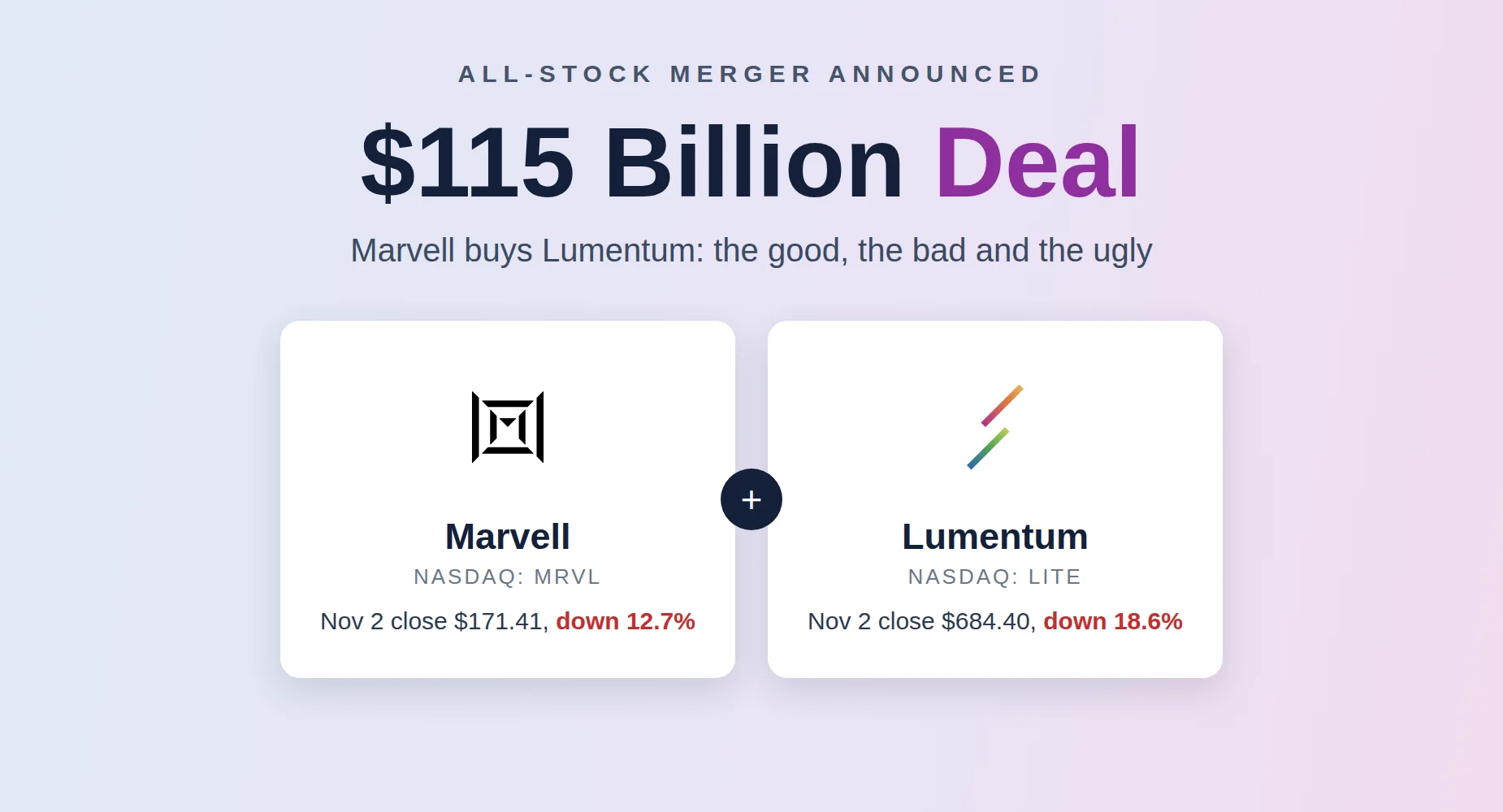
- On November 2, MRVL fell 12.7% and LITE fell 18.6%, leaving LITE about 11% below the value of the stock on offer
- The companies say they have identified more than $1 billion a year in cost savings from combining, and expect the deal to complete in the first half of 2028
- Break fees are unusually large: $5.8 billion payable by Marvell, $2.9 billion by Lumentum, plus a $3.2 billion regulatory fee payable by Marvell
Marvell Technology (MRVL) announced on November 2 that it will acquire Lumentum (LITE) in an all-stock transaction, the largest deal in either company's history and one of the biggest semiconductor takeovers on record. The strategic story is easy to tell: AI data centers are running into the physical limits of copper wiring, and the two companies between them cover most of the path a signal takes from one chip to another. The market's first response was brutal anyway: Marvell fell about 13% on the day and Lumentum about 19%, the biggest fall in the S&P 500 that session.
The deal in brief
An exchange ratio is the number of buyer shares paid for each share of the target company. Here it is fixed at 4.5 Marvell shares for every Lumentum share, with cash paid instead of fractional shares. Enterprise value, the headline $115 billion, counts the value of the whole business including debt taken on, not just the shares. Because the ratio is fixed and the payment is entirely stock, the dollar value of the deal is not fixed at all: it moves with Marvell's share price every day until closing.
| Term | Detail |
|---|---|
| Structure | All-stock acquisition, definitive agreement signed November 1, 2026 |
| Exchange ratio | 4.5 MRVL shares per LITE share, fixed, cash for fractional shares |
| Implied enterprise value | About $115 billion |
| Implied value per LITE share | About $1,132 |
| Premium | About 23.9% over unaffected closing prices on October 28, 2026 |
| Ownership after closing | About 67% Marvell holders, 33% Lumentum holders, fully diluted |
| Boards | Approved unanimously at both companies |
| Leadership | Marvell CEO Matt Murphy stays in charge; three Lumentum directors, including CEO Michael Hurlston, join the board |
| Deal completion expected | First half of calendar 2028 |
| Main conditions | Lumentum shareholder adoption, Marvell shareholder approval of the share issuance and a charter amendment, US antitrust clearance and other regulatory approvals, effective Form S-4 registration |
The first day of trading showed what a fixed ratio means in practice. The $1,132 per share headline was calculated from October 28 prices. By the close on November 2, the 4.5 Marvell shares on offer for each Lumentum share were worth about $771, roughly a third less, because Marvell's stock had fallen. Lumentum closed about 11% below even that reduced figure. That gap has a name: the merger arbitrage spread, the discount at which a target trades below the value of the offer, and it is the market's running price for the risk that a deal is delayed, renegotiated or blocked, plus the cost of waiting.
| November 2, 2026 close | MRVL | LITE |
|---|---|---|
| Closing price | $171.41 | $684.40 |
| Change on the day | -$24.99 (-12.72%) | -$156.30 (-18.59%) |
| Value of 4.5 MRVL shares | $771.35 | |
| LITE discount to offer value | -11.3% |
The good
The logic starts with physics. Inside AI data centers, chips exchange data first within a rack, then across rows of racks, then between buildings. Copper cable handles the short hops cheaply, but as speeds rise its reach shrinks and its power draw grows. Light carries data further on less power, so the industry's centre of gravity is shifting from electrical to optical connections, a shift both companies describe as an inflection point. Co-packaged optics, which places the optical engine directly beside the processor package instead of in a pluggable module across the board, is where that shift is heading, and it demands exactly the close co-design of electronics and photonics that neither company can fully offer alone today.
Marvell brings the electrical side: custom AI processors, digital signal processors that push data through optical links, network switching and silicon photonics, plus Celestial AI, the optical interconnect business it finished buying in February 2026. Lumentum brings the light sources themselves: the lasers at the heart of optical transceivers, pump lasers, optical circuit switching and the indium phosphide manufacturing know-how that is hard to replicate. Put together, the companies claim a combined addressable market of $550 billion and a portfolio spanning every distance from inside a chip package to between data centers.
The growth underneath is real. Lumentum reported first-quarter fiscal 2027 revenue of $1,262.6 million on the same day as the deal, up 136.5% from a year earlier, with a non-GAAP gross margin of 53.2% and guidance for roughly $1.6 billion of revenue in the next quarter. Marvell's last reported quarter, fiscal second-quarter 2027, showed revenue of $2,739 million, up 37%, with data centers at 79% of the total. The companies say they have identified more than $1 billion a year in cost savings from combining the two businesses, and expect the deal to add to Marvell's non-GAAP earnings per share in the first year after it completes. Lumentum holders keep exposure to that growth through a 33% stake in a larger company instead of cashing out. Both companies also supply Nvidia, which invested $2 billion in each earlier this year; Marvell CEO Matt Murphy called the combination "a double down on supporting Nvidia" on CNBC.
The bad
Start with the price. The $115 billion enterprise value works out to about 22.8 times Lumentum's latest quarterly revenue, annualised, and Morningstar estimates the price at roughly 33 times Lumentum's projected core operating profit. Lumentum's growth is spectacular, but a multiple like that assumes the AI optics boom runs for years without a pause. The 23.9% premium also looks modest against the stock's own history: Lumentum had already multiplied over the past two years, and the premium is measured from October 28, before a week in which both stocks slid on the deal reports. Stifel downgraded Lumentum to Hold on the news and cut its price target to $806 from $1,232, a target that now sits close to the value of the Marvell shares on offer rather than the old standalone story.
Marvell is paying with its own highly valued currency. At the November 2 close, Marvell traded at 56.76 times trailing earnings, with a market capitalisation of $150.12 billion and a rating of 63.5. Paying with shares valued that highly is cheap financing while the price holds, and expensive if it does not. The equity Marvell is issuing is worth about $102.5 billion, more than half of Marvell's own market value and more than ten times the $10 billion it paid for Inphi in 2021, its largest deal before this one. Marvell holders are diluted down to about 67% of the combined company, and because the ratio is fixed, they carry the full market risk of the next 18 months: if Marvell's shares fall further, Lumentum holders get less, and pressure to renegotiate or walk away grows on both sides.
The ugly
The calendar is the first problem. Closing is expected in the first half of 2028, and the merger agreement's initial outside date, the deadline after which either side can walk away, is November 1, 2027, extendable in steps to August 1, 2028 while regulatory approvals are outstanding. In AI hardware, 18 months is several product generations. One Lumentum shareholder quoted by MarketWatch called the offer "a trash offer" and pointed at exactly that gap: the consideration is Marvell stock, and Marvell stock can fall a long way before 2028.
Regulatory review is the second problem. The deal needs US antitrust clearance and other approvals, and the agreement prices regulatory failure explicitly: Marvell owes Lumentum a $3.2 billion regulatory termination fee if the deal dies on a final antitrust or foreign-investment ruling, or on a missed outside date with every other condition met. China is a further unknown, since both companies have customers and operations there. The wider break fees are just as striking: $5.8 billion payable by Marvell and $2.9 billion by Lumentum in the standard cases where a board changes its recommendation or takes a better offer. Fees that size say both sides know how much can go wrong.
The third problem is execution. Ryan Koontz, an analyst at Needham, says Lumentum's board "still has some convincing to do" to win its shareholder vote, and questioned the synergy maths directly: "How do you put two different businesses together and save a billion dollars on product costs that don't have much to do with each other?" Axel Rudolph, chief technical analyst at IG Group, put the Marvell side of it bluntly: "This is an enormous bet and investors are right to ask if Marvell is paying too much and taking on too much at once." Marvell has integrated big deals before, Cavium in 2018 and Inphi in 2021, but nothing near this scale, and its most recent one still shows on the books: the earnout tied to Celestial AI had grown to about $750 million by August 2026 as the acquired business outperformed. The combined group would also lean heavily on a short list of hyperscale customers shared by both companies, and would still face Broadcom (AVGO) in custom silicon and optics and Coherent (COHR) in lasers, neither of which stands still for 18 months. If the deal breaks, Lumentum loses its deal support and trades on a momentum story that has already cooled, while Marvell faces the fee, a dented acquisition record and questions about why it reached so far.
What to watch
The Form S-4 filing will be the first hard document: it carries the joint proxy statement, the bankers' fairness work and the detailed synergy numbers behind the press release claims. After that come the two shareholder votes, which Needham's Koontz has flagged as a genuine hurdle on the Lumentum side, then the antitrust timetable in the US and any review in China. The simplest daily check is the gap between Lumentum's share price and the value of the Marvell shares offered for it, which started at about 11%. If that gap shrinks, traders are growing more confident the deal goes through; if it widens, they are growing more doubtful. Marvell's own share price matters just as much, because at a fixed 4.5 ratio it is, quite literally, the price of the deal.
This article is for information purposes only and is not financial advice.